
Coach Hub · For every coach and helper
Coaching words explained
The session plans use short coaching cues. If you've never played, this page explains what each one means and what to look for. It also has the checklist we use to decide when a player is ready for live tackling.
Before any live tackling
Ready for live contact? The checklist
A player moves from bag or shield work to tackling a partner only when you've seen all six of these on most reps. This is decided for each player, not for the whole group. It's fine for some players to stay on bags while others go live.
- Head to the side — cheek to the side of the bag every time, never in front.
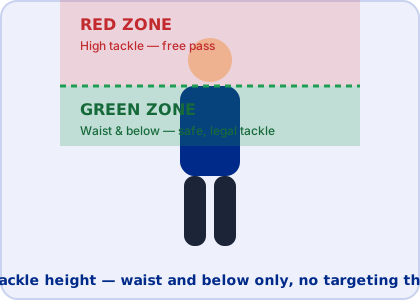
- Waist and below — shoulder contact at the waist or lower.
- Foot in the hoop — gets close before contact, no diving or lunging from distance.
- Wrap and squeeze — the arms wrap round. It's not a shoulder charge.
- Lands safely — falls onto hip and shoulder, not hands first, and gets straight back up (the log roll from the warm-up).
- Wants to — the player says she's ready. Nobody is pushed into contact.
Step up gradually: bag → kneeling partner → walking-pace partner in a narrow channel → jogging pace → live. Drop back a step whenever technique slips.
Stop & reset the drill, every time, if: a head goes in front of the ball carrier · a tackle goes above the waist · a player dives or leaves her feet · someone lands hands-first · two tacklers hit one carrier from opposite sides · a player is upset or hurt. Any head knock: if in doubt, sit them out.
U10 limits: U10 matches play P5 law: tackle-hold, one tackler, waist and below, no rucks (the carrier presents or offloads from the floor). U10s learn tackle and ruck technique in supervised drills, but U10 games always follow P5 law.
A–Z
The words in our session plans
- Bind
- Grip a teammate or the shield with a full arm (hand on the back or shirt) before your chest makes contact. You never enter a ruck without binding.
- Breakdown
- What happens straight after a tackle, when both teams try to win the ball on the ground. U10 (P5) matches have no breakdown. Instead, the tackled player presents or offloads the ball.
- Cheek to cheek / head to the side
- The tackler's cheek goes against the carrier's backside or hip, so the head is beside the carrier, never in front of them. This is the single most important safety cue.
- Connected line / line speed
- Defenders move forward together, in a line, at the same speed, calling to each other. If one player runs ahead or lags behind, a gap opens.
- Decelerate / paddle feet
- Slow down just before contact with small, quick steps (like paddling), so you arrive balanced and under control instead of crashing in.
- Dominant tackle / dominant carry
- A contact the player wins: the tackler stops the carrier and drives them backwards, or the carrier keeps moving forward through the tackle.
- Drift
- A defending choice: slide sideways towards the touchline, pushing the attacker out wide and using the touchline as an extra defender.
- Foot in the hoop
- Imagine a hoop round the ball carrier's feet. The tackler steps their lead foot into it, getting close before contact so they don't have to dive or reach.
- Gainline
- An imaginary line across the pitch where the ball was when play started. Getting over it means your team is going forwards.
- Hold
- A defending choice: stay square, keep your feet and wait. Don't commit until the attacker does.
- Inside-out / protect the inside shoulder
- The defender stays slightly on the attacker's inside (nearer the middle of the pitch), taking away the easy step back inside and forcing them towards the touchline.
- Leg drive
- Short, powerful steps that keep going after contact, whether you're carrying or tackling. It's the opposite of stopping and leaning.
- Offload
- Passing the ball to a teammate during or just after being tackled.
- Pick-and-go
- A player picks the ball up from the base of a ruck and runs straight forward. U12 only in our games.
- Present the ball
- When a tackled player is on the ground, she places the ball back towards her own team at arm's length, so a teammate can pick it up. This is what U10s do instead of a ruck.
- READY stance
- Feet wide, knees bent, hands up, eyes forward. It's the shape players return to in the warm-up and after every contact.
- Reload
- Get back on your feet straight after a tackle or fall and get back into the game.
- Ring of steel
- The tackler's arms locked tight round the carrier's legs, squeezing. It's a warm-up and tackle cue for “wrap, don't just hit”.
- Ruck
- Once a tackled player and the ball are on the ground, at least one player from each team, on their feet and bound, push over the ball to win it. Taught to U10s as technique only, and contested in U12 games.
- Same foot, same shoulder
- If you tackle with your right shoulder, your right foot steps in close (and the same on the left). It keeps the tackler balanced and the head to the side.
- S.T.E.P.
- How to adapt any activity without abandoning it: change the Space, the Task (rules or scoring), the Equipment or the People (team sizes and roles). Every drill in the plans has an “Easier / Harder” line built this way. More on the Coaches page.
- Tackle-hold
- The P5 (U10) tackle: one tackler, waist and below, who holds the carrier until she goes to ground or offloads. No second tackler and no fight for the ball afterwards.
- Touch rugby
- No tackling. A two-handed touch stops the carrier, who then restarts play. We use it to finish sessions and whenever contact isn't suitable (ground, light or numbers).
- Track / eyes on hips
- Follow the attacker by watching their hips, not their shoulders or the ball. Hips don't fake a sidestep.