
Contact Decision Making
Run-sheet
| Time | Length | Activity |
|---|---|---|
| 18:30 | 13 min | Common Warm-Up |
| 18:43 | 2 min | Transition — water, into groups |
| 18:45 | 12 min | Two-Step Tackle Drill & Progression |
| 18:57 | 10 min | Pressure Decision Block |
| 19:07 | 10 min | Defensive Line Zones |
| 19:17 | 10 min | Final Game flex |
| 19:27 | 3 min | Closing huddle |
| 19:30 | 60 of 60 minutes planned | |
Flex: Final Game — stretch if you're on time, trim first if you're behind. Never cut the warm-up or the closing huddle. Clock times assume an 18:30 start.
Before kick-off
Kit
- 30 cones
- 8–10 rugby balls
- 2 tackle bags
- 4 tackle shields
- Bibs, water, first aid kit
Session focus
Objective: build a confident, technically correct tackle from a short run-up and a decision, then apply hold/drift/tackle defending and connected line speed in games.
Drills
Compact view hides the goals, “looks like good” and easier/harder lines, leaving the set-up, key points, stop & reset and U10 limits. Tap any diagram to open it full size.
13-Minute Warm-Up
Goal: the same warm-up every week, so players learn it once and can run it themselves. Pulse Raiser (0–3 min) → Dynamic Mobility (3–8 min) → Contact Confidence (8–13 min), cued by a 5-song playlist.
Full routine, diagrams and cues in the warm-up guide.
Coaching point: once players know the routine, let them lead the calls. Allow 2 minutes either side for arrivals and transition — the rest of the session begins at the 15-minute mark.
Two-Step Tackle Drill & Progression
Goal: build a confident, technically correct tackle from a short run-up, progressing from a static bag to a decision under pressure.
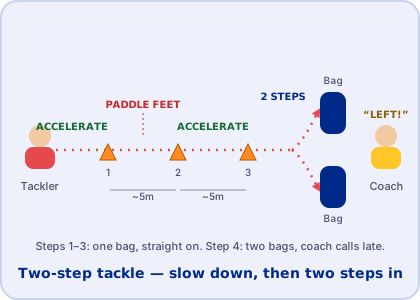
1. Accelerate – decelerate – accelerate: using three cones about 5m apart, players accelerate to the first cone, decelerate and paddle feet between the first and second cone, then accelerate again from the second cone to the third.
2. Tackle the static bag: one player holds a tackle shield upright on the ground; the second player takes two steps and makes the tackle.
3. Add the run-up: accelerate, slow down and paddle feet, then two steps and drop height into the tackle — now closing from distance.
4. Add the decision: two bags, with a coach stood behind them calling left or right. The player starts in the middle, between the bags, for their run-up and reacts to the call.
Key points: foot in the hoop, same leg · same shoulder, contact in the middle of the bag, finish on top of the bag. From step 3 onward, emphasise the deceleration phase before the two steps in.
- Looks like good: the player slows with small paddle steps before the bag, then two steps, foot in the hoop, cheek to the side, finishing on top of the bag.
- Stop & reset if: a player runs straight in at full pace without slowing, or the head goes in front of the bag.
- Easier: stop at step 2. · Harder: coach calls left or right later.
U10: all four steps are bag work, so U10s run the full progression.
Pressure Decision Block
Goal: build controlled defensive decisions in a 1v1, then progress toward live tackling as confidence and technique allow.
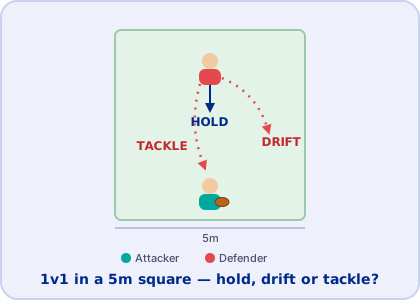
5m × 5m square, 1v1 attacker vs defender. Defender's choice — hold, drift or tackle — depending on what the attacker does. Start as touch: if the touch is made, the attacker stops and the defender can add a two-step tackle to build tackle confidence. Progress to full contact only for players who meet the readiness checklist.
Coaching point: stay square, read the attacker's cues, be patient, decide early. Only raise the contact level once the technique from the tackle drill above is solid.
- Looks like good: the defender stays square, keeps her feet and chooses early: hold, drift or tackle.
- Stop & reset if: the defender dives in from too far away or goes high.
- Easier: touch only. · Harder: give the attacker a support runner.
U10: full contact for U10 means a P5 tackle-hold: one tackler, waist and below, and the carrier presents the ball. No contest after the tackle.
Defensive Line Zones
Goal: reward a fast, connected defensive line by linking field position directly to score.
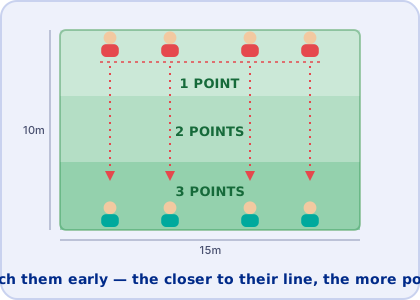
15m × 10m channel, 5v5 (adjust numbers as needed). Cones mark three zones across the pitch; attackers and defenders start at opposite ends. On the coach's call, attackers run straight and defenders close to make the touch — the zone where the touch is made decides the points, with the zone closest to the attackers' start scoring highest. Swap attack and defence and keep a running score for each team.
Progressions: points only count if all attackers are touched in the same zone · add a ball to the attacking team · encourage a connected defensive line · allow attackers to evade.
Final Game
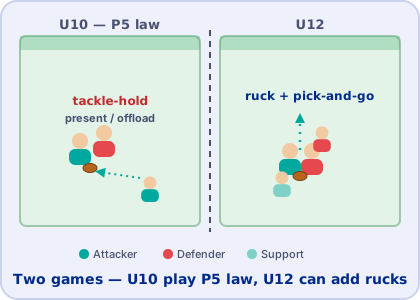
5v5 touch (adjust numbers as needed). Vary the rules as the game goes on to encourage space and decision-making, e.g. defenders swapping sides. U12: can add rucks and pick-and-go, then progress to full contact once the group meets the readiness checklist.
U10 game — P5 law: tackle-hold only (one tackler, waist and below). No ruck contest: the tackled player presents the ball back or offloads from the floor, and a teammate picks it up.
Closing Huddle
Walk it in, sit down, water. Ask two questions and take a couple of answers each: “What did we get better at tonight?” and “What's one thing you'll practise before next week?” Give one specific shout-out per group, then say what's coming next Thursday.
Coach check: this is also the moment to note any knocks, bumps or head contacts for parents at pick-up. If in doubt, sit them out.
Plan B, session jobs and emergency steps: see the laminated coach safety sheet.
Plan B — when the night doesn't go to plan
- Fewer coaches: never fewer than two adults on site. Contact drills need a coach on each grid. If you can't staff a separate U10 grid and U12 grid, run the contact work as bag/shield work or touch for both groups, and keep live tackling for a night when you can.
- Low or uneven numbers: with fewer than 6 in an age group, run the skill blocks as one channel and the game as 3v3 or 4v4. Don't top up a U10 contact game with U12 players; do it in touch games only. With an odd number, make the spare player the “caller” or ball feeder and rotate them in every rep.
- Wet or hard ground: no falling, rolling or ground contact on waterlogged, frozen or rock-hard ground. Swap to bag/shield work standing up and extend the touch game.
- Poor light: move to the best-lit area, use bright bibs, and stop live contact as soon as coaches can't clearly see head position. Finish with touch.
- Running late: trim the flex game first, never the warm-up or the closing huddle.
- A player doesn't want to do contact tonight: make her the ball carrier, caller or scorer. She joins in the tackling when she chooses. No pressure and no comment.