
Dominant Collision
Run-sheet
| Time | Length | Activity |
|---|---|---|
| 18:30 | 13 min | Common Warm-Up |
| 18:43 | 2 min | Transition — water, into groups |
| 18:45 | 8 min | Shield Contact Block |
| 18:53 | 8 min | Corridor Contest Block |
| 19:01 | 12 min | Gainline Rugby |
| 19:13 | 12–14 min | Touch Rugby Plus flex |
| 19:25 | 3 min | Closing huddle |
| 19:28 | 58 of 60 minutes planned · 2 min buffer | |
Flex: Touch Rugby Plus — stretch if you're on time, trim first if you're behind. Never cut the warm-up or the closing huddle. Clock times assume an 18:30 start.
Before kick-off
Kit
- 30 cones
- 8–10 rugby balls
- 4 tackle shields
- 2 tackle bags
- Bibs, water, first aid kit
Session focus
Objective: win collisions as both ball carrier and defender, through strong body position, leg drive and confidence in contact.
Drills
Compact view hides the goals, “looks like good” and easier/harder lines, leaving the set-up, key points, stop & reset and U10 limits. Tap any diagram to open it full size.
13-Minute Warm-Up
Goal: the same warm-up every week, so players learn it once and can run it themselves. Pulse Raiser (0–3 min) → Dynamic Mobility (3–8 min) → Contact Confidence (8–13 min), cued by a 5-song playlist.
Full routine, diagrams and cues in the warm-up guide.
Coaching point: once players know the routine, let them lead the calls. Allow 2 minutes either side for arrivals and transition — the rest of the session begins at the 15-minute mark.
Shield Contact Block
Goal: build leg drive in a relay format, then apply it directly as a ball carrier against the same shields.

Start as the Leg Drive Relay: teams relay through a shield station, start 3m out, accelerate into contact, drive the shield through a 5m marked zone, return to the team, next player goes. After a few rounds, switch to the Ball Carrier Challenge on the same shields: carrier accelerates into contact, maintains body position, drives beyond the collision point for maximum distance.
Coaching point: low body height, short powerful steps, keep feet moving, drive continuously, strong ball security, eyes forward.
- Looks like good: the carrier dips before contact, ball held tight away from the shield, feet keep pumping through the zone.
- Stop & reset if: the carrier drops or leads with the head, or the shield holder charges forward.
- Easier: walk in from 1m. · Harder: start from 5m; holder resists harder.
U10: shield held by a coach or a similar-sized U10.
Corridor Contest Block
Goal: build teamwork in a 2-on-1 tackle, then go 1-on-1 for repeated, resilient collision efforts.
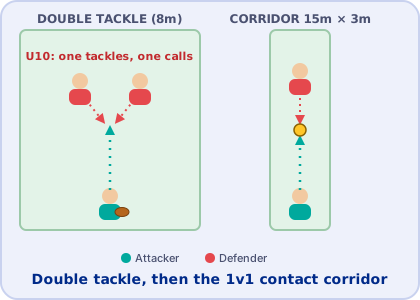
Start as the Double Tackle Competition: 8m channel, one attacker vs two defenders. Attacker runs the channel; defenders communicate and tackle together to stop the momentum. After a few reps, drop to one defender and it becomes the Contact Corridor: 15m × 3m corridor, ball carrier vs defender contesting the collision. Reset and repeat, rotating positions regularly throughout.
Coaching point: communicate early, work together, drive the feet, finish the tackle, stay low, recover quickly, compete every repetition.
- Looks like good: the defender gets cheek to the side and wraps, and the carrier stays low and keeps driving.
- Stop & reset if: two defenders hit one carrier from opposite sides, or anyone goes high.
- Easier: widen the corridor; carrier jogs. · Harder: shorten the start distance.
U10: skip the double-tackle phase. The second defender makes a touch and calls instead, because P5 tackles are one-on-one only. Go straight to the one-defender Contact Corridor.
Gainline Rugby
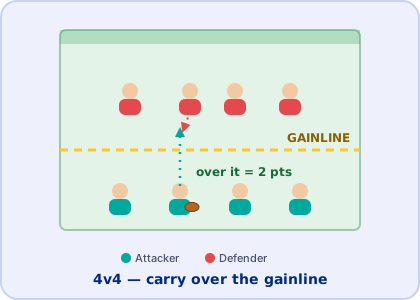
25m × 20m pitch, two separate 4v4 games. Attack: carry positively, attack space, support the ball carrier. Defence: stop momentum, communicate, win collisions, reload quickly.
U10 game — P5 law: tackle-hold only (one tackler, waist and below). No ruck contest: the tackled player presents the ball back or offloads from the floor, and a teammate picks it up.
Touch Rugby Plus
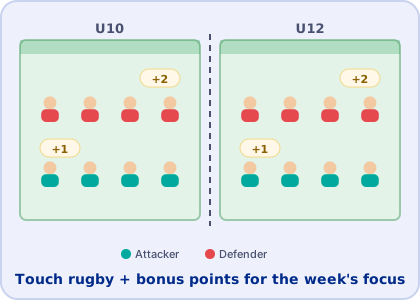
Standard touch rugby with bonus points for positive carries, great support lines, communication and outstanding effort. This is the flex block: let it run to 14 minutes if the session's on schedule, or cut to 10 if you're behind.
Scoring
- Try = 5
- Gainline Won = 2
- Dominant Carry = 1
- Dominant Tackle = 1
Closing Huddle
Walk it in, sit down, water. Ask two questions and take a couple of answers each: “What did we get better at tonight?” and “What's one thing you'll practise before next week?” Give one specific shout-out per group, then say what's coming next Thursday.
Coach check: this is also the moment to note any knocks, bumps or head contacts for parents at pick-up. If in doubt, sit them out.
Plan B, session jobs and emergency steps: see the laminated coach safety sheet.
Plan B — when the night doesn't go to plan
- Fewer coaches: never fewer than two adults on site. Contact drills need a coach on each grid. If you can't staff a separate U10 grid and U12 grid, run the contact work as bag/shield work or touch for both groups, and keep live tackling for a night when you can.
- Low or uneven numbers: with fewer than 6 in an age group, run the skill blocks as one channel and the game as 3v3 or 4v4. Don't top up a U10 contact game with U12 players; do it in touch games only. With an odd number, make the spare player the “caller” or ball feeder and rotate them in every rep.
- Wet or hard ground: no falling, rolling or ground contact on waterlogged, frozen or rock-hard ground. Swap to bag/shield work standing up and extend the touch game.
- Poor light: move to the best-lit area, use bright bibs, and stop live contact as soon as coaches can't clearly see head position. Finish with touch.
- Running late: trim the flex game first, never the warm-up or the closing huddle.
- A player doesn't want to do contact tonight: make her the ball carrier, caller or scorer. She joins in the tackling when she chooses. No pressure and no comment.